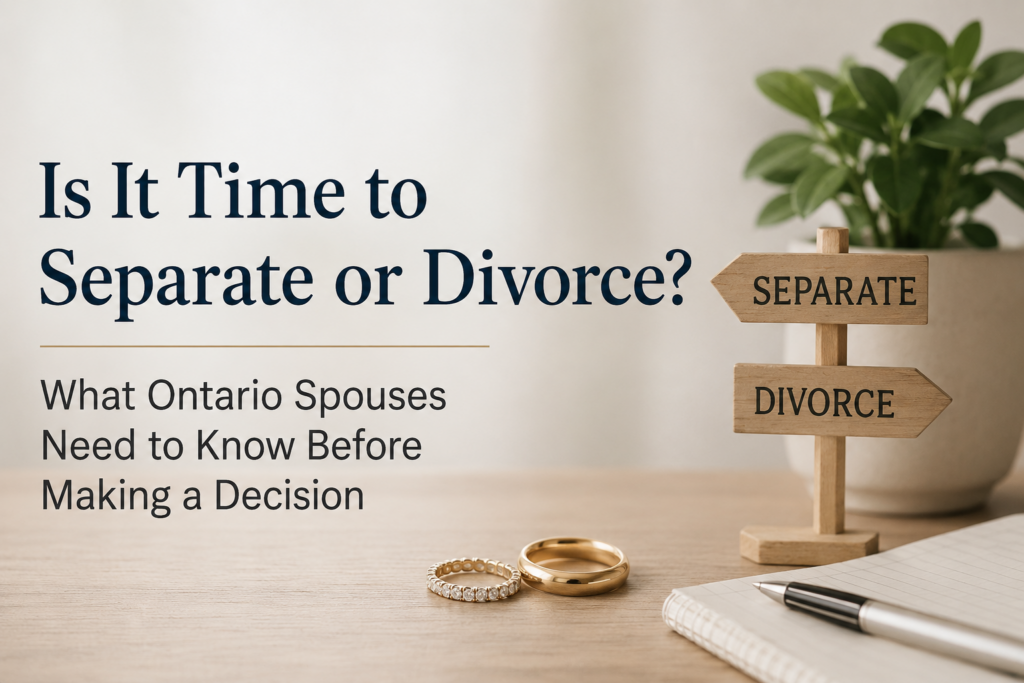
Is It Time to Separate or Divorce? What Ontario Spouses Need to Know Before Making a Decision
First Things First: What Does Separation Actually Mean in Ontario?
Many people assume that separation involves paperwork, a court visit, or some kind of official process. In Ontario, it does not.
You are legally separated the moment you and your spouse decide that the marriage is over and begin living separate lives — even if you are still living under the same roof. There is no form to file, no judge to see, and no government registration required.
What matters is the date of separation, because that date starts a very important clock. If you ever decide to pursue a divorce, you will need to have been separated for at least one year first.
Important: Write down the date you separated and keep a record of it. This date matters legally.
So What Is a Separation Agreement — and Do You Need One?
While separation itself is informal, the issues that come with it are not. Who keeps the house? Who pays support? Who does the kids live with? These questions need answers — and a Separation Agreement is how most Ontario couples document those answers in a legally binding way.
A Separation Agreement is a written contract between you and your spouse that covers:
- Division of property, assets, and debts
- Spousal support (amount and duration)
- Child custody and parenting time arrangements
- Child support payments
- Any other financial matters specific to your situation
You do not need a court to approve a Separation Agreement. But for it to be legally binding and enforceable in Ontario, it must be:
- In writing
- Signed by both spouses
- Witnessed by a third party
- Ideally reviewed by independent lawyers for each spouse
Skipping the agreement might seem easier in the short term. But without one, disputes over money, property, or children can drag on for years — and become far more expensive than the agreement would have been.
What Is Divorce in Ontario — and How Is It Different?
Divorce is the legal end of a marriage. It requires going through the court system, and once a divorce order is granted, the marriage is officially over. Both spouses are free to remarry.
In Canada, divorce is governed by the federal Divorce Act — so the rules are the same whether you are in Ontario, British Columbia, or anywhere else in the country.
What Are the Grounds for Divorce in Ontario?
There is only one legal ground for divorce in Canada: marriage breakdown. This can be proven in three ways:
- Separation for one year — by far the most common route. You simply need to have been living separate and apart for at least 12 months.
- Adultery — you must prove that your spouse had an extramarital affair. This is rarely used because of the difficulty of proof.
- Physical or mental cruelty — also rarely used, as it requires demonstrating a pattern of abuse.
Most Ontario couples choose the one-year separation route. It is straightforward, does not require proving fault, and avoids unnecessary conflict.
Separation vs. Divorce in Ontario: Side-by-Side Comparison
Not sure which path applies to your situation? Here is a quick breakdown:
Legal Separation | Divorce | |
Marital Status | Still legally married | Marriage legally ended |
Can You Remarry? | No | Yes |
Court Required? | No | Yes |
Minimum Wait Time | None | 1 year of separation |
Cost | Generally lower | Generally higher |
Reversible? | Yes | No — must remarry |
Property Division | Private agreement | Court finalized |
Spousal / Child Support | Set in agreement | Set by court order |
Which One Is Right for You?
There is no single right answer — it depends entirely on your circumstances. Here are some common situations to help you think it through:
Separation may make more sense if…
- You are not 100% sure the marriage is over and want to leave the door open for reconciliation
- You or your spouse have religious beliefs that discourage divorce
- You need to remain married for health insurance, pension benefits, or tax reasons
- You want to resolve financial and parenting issues privately before involving a court
- You want to keep things low-conflict, especially for the sake of your children
Divorce may make more sense if…
- You are certain the marriage is permanently over
- You or your spouse want to remarry in the future
- You want your marital status officially and legally changed
- You need a court-enforceable order for support or property that your spouse will not agree to voluntarily
- You want complete legal finality and closure
Remember: You can be separated for years without ever divorcing. Many Ontario couples choose this path — and it is perfectly valid legally.
What Happens to Property When You Separate in Ontario?
This is one of the biggest concerns people have when a marriage ends — and understandably so.
Ontario’s Family Law Act sets out the rules for dividing property when spouses separate. The goal is equalization: each spouse gets an equal share of the net wealth accumulated during the marriage.
This does not mean everything is split 50/50 automatically. What it means is that the increase in each spouse’s net worth during the marriage is calculated, and the spouse who gained more pays the other an equalization payment.
There are some important exceptions. Property you owned before the marriage, inheritances, and gifts from third parties are generally excluded — though there are nuances.
The matrimonial home is treated differently from all other property under Ontario law. Both spouses have equal rights to live in the home, regardless of whose name is on title — even after separation.
A Step-by-Step Look at the Separation Process in Ontario
Step 1 — Decide to Separate. One or both spouses decide the marriage is over. Note the date — this is your official separation date.
Step 2 — Live Separate and Apart. In most cases, one spouse moves out. In some situations, couples separate while still sharing the home, but must truly be living independently (separate bedrooms, no joint activities, no presenting as a couple).
Step 3 — Talk to a Family Lawyer. Before making any decisions about property, support, or children, it is important to understand your legal rights. A family lawyer can walk you through your options.
Step 4 — Negotiate a Separation Agreement. Work with your lawyer (and your spouse and their lawyer) to reach fair terms on all key issues.
Step 5 — Sign the Agreement. Once both parties agree, sign the document in the presence of a witness. The agreement is now legally binding.
A Step-by-Step Look at the Divorce Process in Ontario
Step 1 — Confirm One Year of Separation. Wait until you have been separated for at least one year. You can start the paperwork before the year is up, but the divorce order will not be issued until the full year has passed.
Step 2 — File a Divorce Application. You or your lawyer files a divorce application with the Ontario Superior Court of Justice. This can be done jointly (both spouses agree) or by one spouse alone.
Step 3 — Serve Your Spouse. If you are filing alone, your spouse must be formally served with the application and given a chance to respond.
Step 4 — Resolve All Outstanding Issues. Property division, support, and parenting arrangements must all be settled before a divorce is granted — either through agreement or court hearings.
Step 5 — Receive the Divorce Order. A judge issues the Divorce Order. It becomes final 31 days later. At that point, the marriage is legally over and both parties are free to remarry.
Common Questions Ontario Spouses Ask
Can I start dating while separated?
Yes. There is no law preventing you from dating while separated in Ontario. However, keep in mind that new relationships can sometimes affect spousal support negotiations — and it is worth discussing with your lawyer if that is a concern.
Do I have to go to court to separate?
No. Separation in Ontario does not require any court involvement. You only need the court if you cannot reach an agreement with your spouse and need a judge to decide matters for you — or when you file for divorce.
How long does a divorce take in Ontario?
An uncontested divorce (where both spouses agree on all issues) typically takes 4 to 6 months after filing. A contested divorce, where disputes go before a judge, can take 1 to 3 years or longer.
How much does a divorce cost in Ontario?
Court filing fees start at around $260 for a joint application. Total costs vary widely — a simple uncontested divorce may cost a few thousand dollars in legal fees, while a contested divorce involving multiple hearings can run into tens of thousands.
Can we write our own separation agreement without lawyers?
Technically, yes. But it is risky. Courts can set aside agreements that were signed without independent legal advice, without full financial disclosure, or under pressure. A lawyer does not need to be expensive — even a brief consultation can protect you significantly.
Does separation automatically turn into divorce after a certain number of years?
No. In Ontario, separation does not automatically become divorce. You can remain legally separated indefinitely. Divorce only happens when you actively apply for it through the courts.
Speak With a Family Lawyer Before Making Any Decisions
Whether you are thinking about separating, drafting an agreement, or ready to file for divorce, the decisions you make in the early stages of a marriage breakdown can have long-term consequences.
At Rohr Law Firm, we help Ontario families navigate separation and divorce with clarity, compassion, and practical legal advice. We understand that this is not just a legal process — it is one of the most difficult transitions a person can go through.
Every family situation is different. The information in this article is general in nature and is not a substitute for legal advice. Contact Rohr Law Firm to speak with an Ontario family law lawyer about your specific circumstances.
Frequently Asked Questions
Yes. There is no law preventing you from dating while separated in Ontario. However, keep in mind that new relationships can sometimes affect spousal support negotiations — and it is worth discussing with your lawyer if that is a concern.
No. Separation in Ontario does not require any court involvement. You only need the court if you cannot reach an agreement with your spouse and need a judge to decide matters for you — or when you file for divorce.
An uncontested divorce (where both spouses agree on all issues) typically takes 4 to 6 months after filing. A contested divorce, where disputes go before a judge, can take 1 to 3 years or longer.
Court filing fees start at around $260 for a joint application. Total costs vary widely — a simple uncontested divorce may cost a few thousand dollars in legal fees, while a contested divorce involving multiple hearings can run into tens of thousands.
Technically, yes. But it is risky. Courts can set aside agreements that were signed without independent legal advice, without full financial disclosure, or under pressure. A lawyer does not need to be expensive — even a brief consultation can protect you significantly.
No. In Ontario, separation does not automatically become divorce. You can remain legally separated indefinitely. Divorce only happens when you actively apply for it through the courts.
Separation means you and your spouse have decided to live apart and end the relationship, but you remain legally married. Divorce is a formal court process that legally ends the marriage entirely. While the rules for separation vary slightly by province, divorce is governed by federal law (the Divorce Act) and is consistent across all of Canada.
A properly drafted Separation Agreement can protect your financial interests by clearly documenting property division, support obligations, and debt responsibility. Without a written agreement, you may have limited legal recourse if disputes arise later. It is always best to have a family lawyer review any agreement before you sign.
Recent Posts
-
What to Do If Children's Aid Society (CAS) Contacts You in Oshawa
-
Uncontested Divorce Ontario: How to Get a Simple Divorce Faster
-
Who Gets the House in a Divorce in Ontario? Property Division Rules Explained
-
Spousal Support Duration Ontario: How Long You Actually Have to Pay
-
Child Support for Self-Employed Parents in Ontario | Rohr Law
-
Common-Law Rights Ontario | Oshawa Family Lawyer Explains
-
Emergency Custody Ontario & Restraining Orders | Oshawa Family Lawyer
-
Parenting Time vs. Custody: What Ontario's New Family Law Language Actually Means
-
Is It Time to Separate or Divorce? What Ontario Spouses Need to Know Before Making a Decision
-
What Is the Difference Between Separation and Divorce in Ontario?