Who Gets the House in a Divorce in Ontario? Property Division Rules Explained
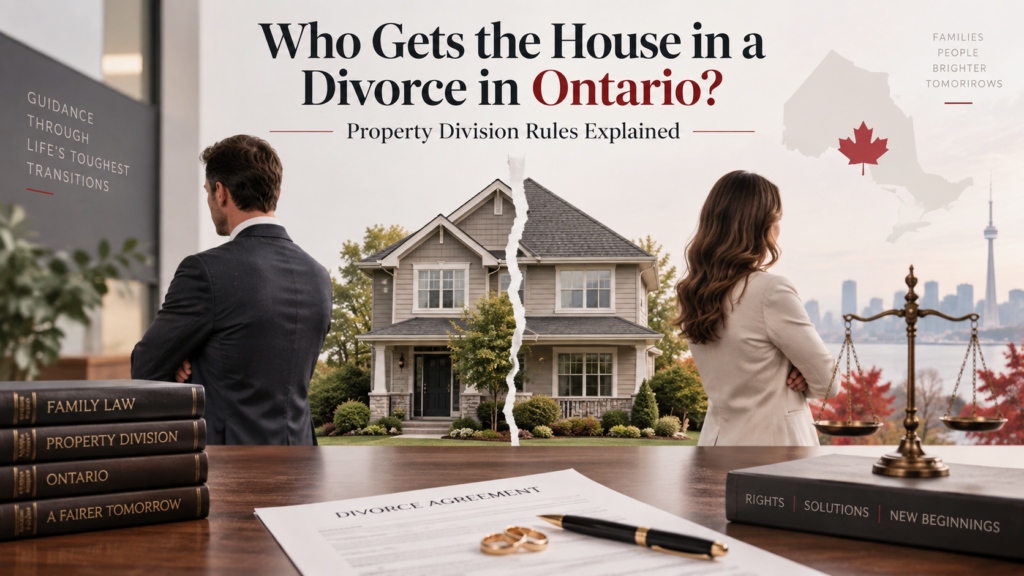
The house is often the biggest asset in a separation. It is also the one that causes the most stress.
Many Oshawa homeowners ask the same question early on. Who actually gets the house in a divorce in Ontario?
The answer depends on ownership, marriage status, and a legal process called equalization. This guide breaks it down.
Key Takeaways |
|
Legally reviewed by Rohr Law Professional Corporation, Oshawa, Ontario | Last updated: September 2026
Buyout vs Sale: Which Option Fits Your Situation?
Factor | Spousal Buyout | Sale of the Home |
Who keeps the home | One spouse keeps it | Neither spouse keeps it |
Cash needed upfront | Yes, to pay out the other spouse’s share | No, proceeds are split after sale |
Requires refinancing | Usually yes | No |
Best fit for | One spouse wants stability, e.g. for children | Neither spouse can afford it alone |
The Matrimonial Home Rule in Ontario
Ontario gives special legal status to the matrimonial home. This is the home the couple lived in as a family right before separation.
Both married spouses have an equal right to stay in the matrimonial home. This applies even if only one spouse’s name is on the title.
What Is Equalization of Net Family Property?
Ontario does not simply split the house itself in most cases. Instead, it uses a process called equalization of net family property.
This process compares what each spouse owned at marriage and at separation. The spouse with the higher increase in value usually pays the other an equalization payment.
The house is one asset counted inside this larger calculation, not judged completely on its own.
Does It Matter Whose Name Is on the Title?
For married spouses, title alone does not decide who keeps the home. The matrimonial home is treated differently than other property.
Even if the home is only in one spouse’s name, its full value is usually included in equalization, without deducting its value at the date of marriage.
Common-Law Couples and the House: Different Rules Apply
Common-law couples do not get the same automatic matrimonial home protection. We explain this gap in detail in our guide to common-law rights in Ontario.
For common-law partners, title and financial contribution usually matter far more directly.
Options When You Can’t Agree Who Keeps the House
Couples often start out disagreeing about the home. A few common paths can resolve this.
- One spouse buys out the other’s share
- The home is sold and proceeds are divided
- One spouse keeps the home temporarily, then sells later
- A court decides, if negotiation fails
Buying Out Your Spouse’s Share of the Home
A buyout lets one spouse keep the home. The other spouse receives their share of the value in cash or through other assets.
This usually requires a professional appraisal. It may also require refinancing the mortgage in one spouse’s name alone.
Selling the Home and Splitting Proceeds
Selling is often the simplest option. Both spouses agree on a sale, then split the net proceeds as part of the overall settlement.
This route avoids ongoing financial ties between former spouses tied to one property.
What Happens to Mortgage Debt During Property Division?
Mortgage debt is factored into the value of the home. A larger mortgage balance reduces the equity that gets divided.
Both spouses may remain responsible for a joint mortgage until it is formally refinanced or paid out, even after separation.
Trust Claims and the Family Home
Sometimes a spouse or partner contributed money or work to a home without being on title. In these cases, a trust claim may help recover a fair share of the home’s value.
These claims are common in common-law separations, but can also apply in some married-spouse disputes involving family gifts or pre-marriage contributions.
How Property Division Connects to Spousal and Child Support
Property division rarely stands alone. It often connects directly to spousal support and child support decisions. For example, keeping the family home may affect how long support payments are needed, a topic we cover in our guide to spousal support duration in Ontario.
How a Property Division Lawyer Protects Your Home
A fair outcome depends on accurate valuations and a clear understanding of Ontario’s equalization rules. Our property division team helps Oshawa clients protect their share of the family home, whether that means negotiating a buyout, managing a sale, or pursuing a trust claim.
Protect Your Share of the Family Home Today
The house is too important to leave to guesswork. Rohr Law helps Oshawa clients understand their real options and protect their financial future.
Book a consultation with our property division team today.
Frequently Asked Questions
Not exactly. Its value is included in the broader equalization calculation, which can result in different outcomes.
Yes, in many cases. Both married spouses generally have an equal right to stay in the matrimonial home.
For married spouses, the matrimonial home is still usually included in full for equalization purposes, regardless of title.
No. Common-law partners generally rely on ownership and financial contribution, not automatic matrimonial home rules.
Yes, in some cases, if spouses cannot agree and a fair resolution requires it.
Recent Posts
-
What to Do If Children's Aid Society (CAS) Contacts You in Oshawa
-
Uncontested Divorce Ontario: How to Get a Simple Divorce Faster
-
Who Gets the House in a Divorce in Ontario? Property Division Rules Explained
-
Spousal Support Duration Ontario: How Long You Actually Have to Pay
-
Child Support for Self-Employed Parents in Ontario | Rohr Law
-
Common-Law Rights Ontario | Oshawa Family Lawyer Explains
-
Emergency Custody Ontario & Restraining Orders | Oshawa Family Lawyer
-
Parenting Time vs. Custody: What Ontario's New Family Law Language Actually Means
-
Is It Time to Separate or Divorce? What Ontario Spouses Need to Know Before Making a Decision
-
What Is the Difference Between Separation and Divorce in Ontario?